

Turbomachinery 4: Three Dimensional Flow Field Analysis
From two-dimensional blade cascades to complex three-dimensional flow structures, explore how turbomachinery blades turn the flow, generate losses, and redistribute momentum, and how simplified throughflow methods connect aerodynamic theory with CFD.

Turbomachinery 3: Equations and Principles
Explore the fundamental equations and numerical principles behind turbomachinery CFD, from rotating reference frames, angular momentum, and rothalpy to turbulence modelling and boundary conditions. Learn how ANSYS TurboGrid transforms complex blade geometry into structured computational meshes, and why mesh topology, refinement, and quality are essential for reliable simulations.

Turbomachinery 2: Analysis and Performance of Turbomachinery
Turbomachinery performance and blade geometry are two descriptions of the same energy-conversion problem. This note develops total-property analysis, Euler work, compressor and turbine efficiency, similarity parameters and characteristic maps, then connects them to practical blade design using Ansys BladeGen and BladeEditor, including flow paths, spanwise layers, camber and thickness definitions, parameterization, periodic CFD domains and geometry export.

Turbomachinery 6: Analysis and design in Turbomachines
Axial compressors, axial turbines, centrifugal compressors, radial turbines and hydraulic machines are different implementations of the same turbomachinery principles. This note develops their velocity triangles, work transfer, reaction and loading before connecting ideal mean-line behaviour to real losses, diffusion, wakes, secondary flow, slip, diffusers, volutes, hydraulic head and cavitation.

Turbomachinery 1: Introduction
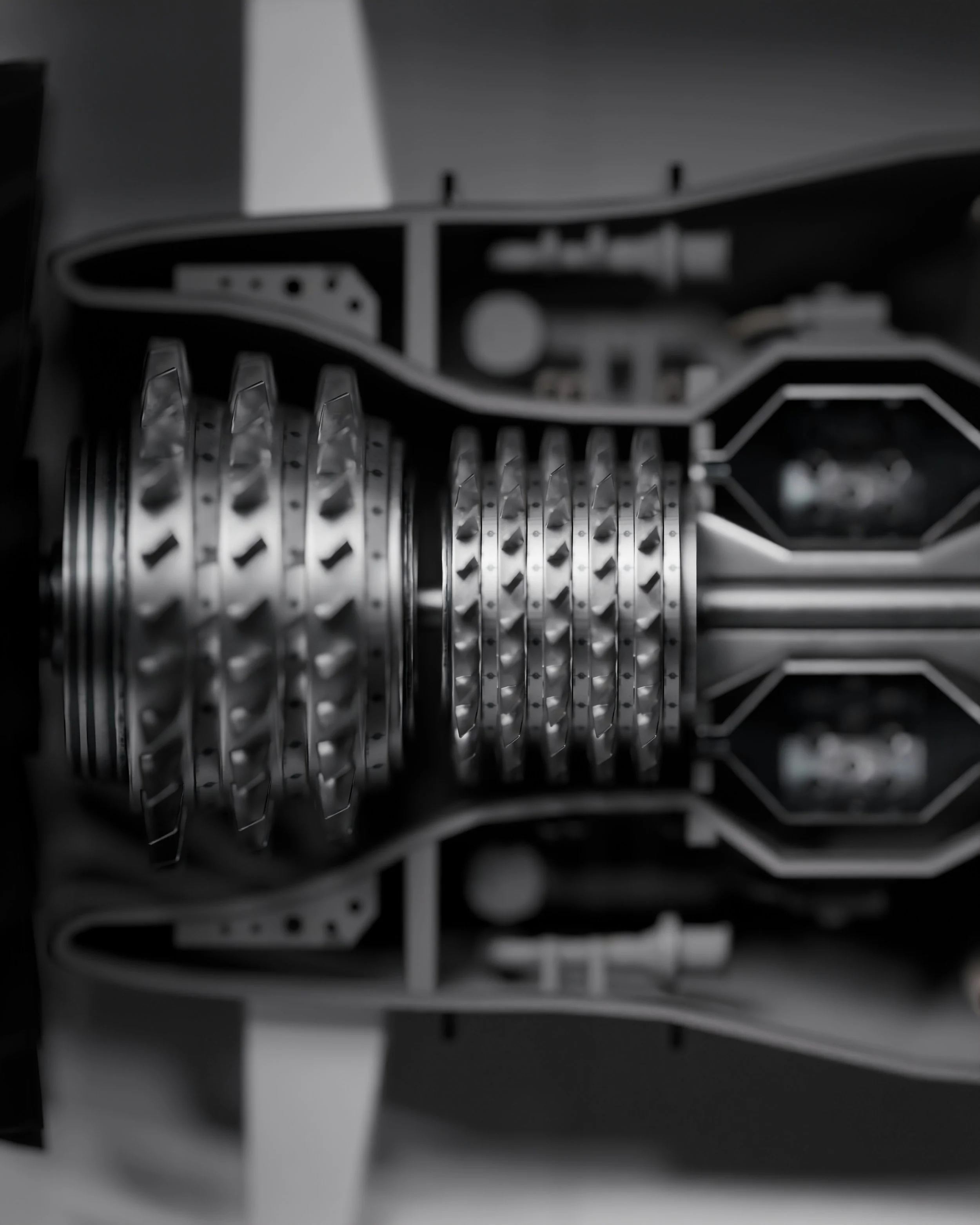
Turbomachinery is built around a simple idea: exchanging energy between a rotating machine and a flowing fluid. The flow physics behind that exchange, however, are anything but simple. This chapter introduces the fundamental architecture of turbines, compressors, and pumps, then explores why their internal flows are three-dimensional, turbulent, compressible, and inherently unsteady. It also introduces the role of CFD in modern turbomachinery design, from understanding secondary flows and tip-clearance effects to comparing design changes and identifying aerodynamic losses.